
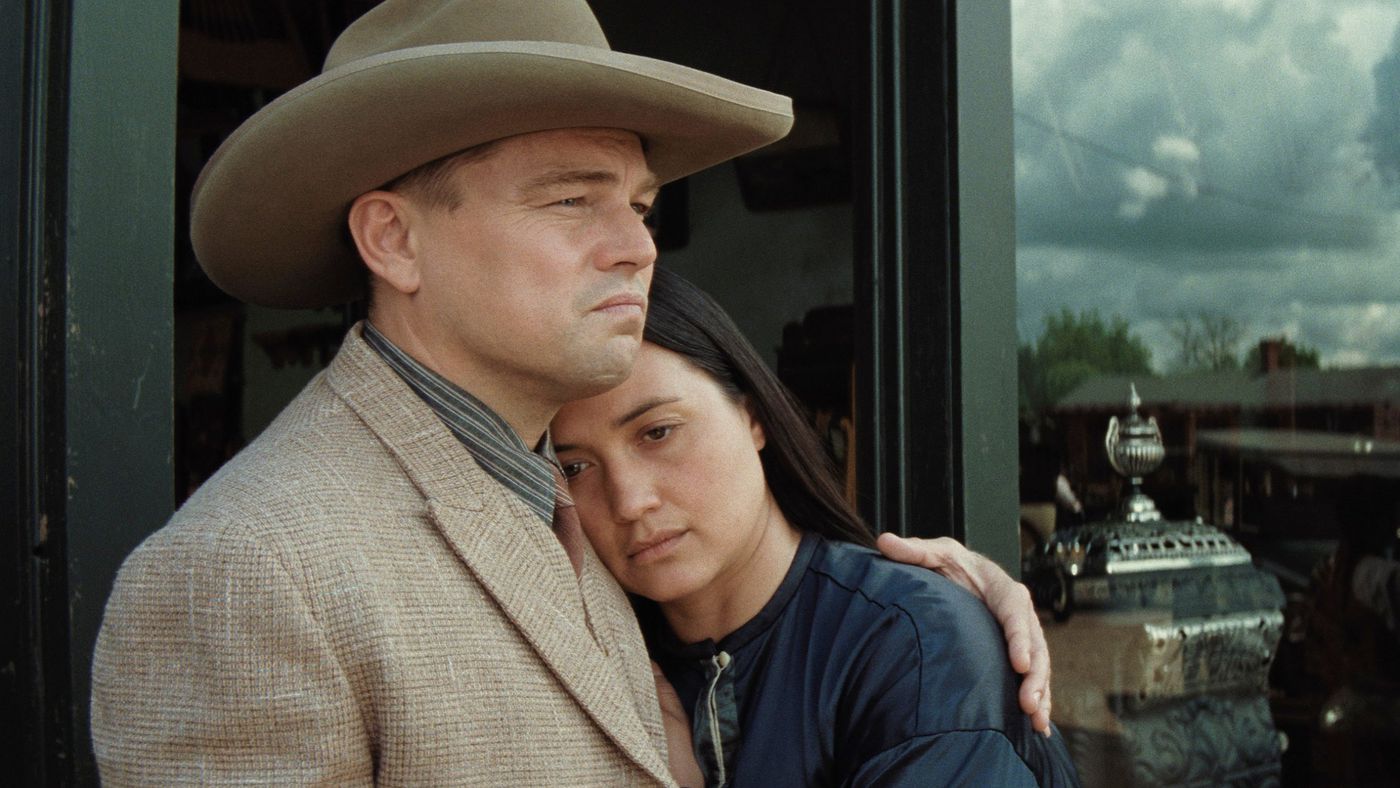
I didn’t want to see Killers of the Flower Moon. I knew enough about the film and the Reign of Terror to know I didn’t want to put more images of whites brutalizing indigenous people in my brain.
But I saw it anyway. I’m a zealous movie fan, and I prep for Oscar night like it’s the final exam for my favorite year-long college course. I figured I could tolerate witnessing more fictional depictions of racial violence if the Osage could tolerate the real-life version. I figured the beauty and importance of the film might outweigh the pain of the brutality. I also figured there would be some satisfaction by the end, given the previews.
I was wrong, on all counts. As indigenous actor Devery Jacobs said, Killers of the Flower Moon is a “hellfire” of a movie. But what hurt my heart most was its normalization of patriarchy and romanticization of domestic violence.
To my surprise, the murders were far less graphic than I expected. Instead of watching humans brutalize each other, we mostly see the gory aftermath of racial violence (including a bizarre, gratuitous scene of an autopsy in the woods with the public gawking at Anna Brown’s naked pried-open ribcage). But the sexism was both blithe and unrelenting from beginning to end.
Previews and promotional images for Killers of the Flower Moon made this seem like a love story. They implied that Ernest (Leonardo DiCaprio) joins Mollie (Lily Gladstone) and her family to defeat the powerful evil white men. But he doesn’t, and this is not a love story.
First, we’re given no sense of who the Osage woman Mollie Kyle is, nor who any of the Native women (or men) are as full human beings. Filmmaker Martin Scorsese raises interesting questions about their personhood but leaves most unanswered. Nearly all Mollie’s scenes show her suffering: Mollie stoically bearing pain or humiliation, Mollie wailing with grief, Mollie writhing helpless and sweaty alone in bed, Mollie embracing her husband after learning he killed her sister.
Previews and promotional images made this seem like a love story. They implied that Ernest joins Mollie and her family to defeat the powerful evil white men.
But he doesn’t, and this is not a love story.
But why? We get no backstory, no sense of her interiority, no three-dimensional humanity. It’s as if Scorsese simply wants us to take at face value that being indigenous — especially an indigenous woman — is just fucked up and hard. Nothing else to see here!
As a non-person, it’s taken for granted that Mollie falls in “love” with Ernest. But why on Mother Earth she does is beyond me. Mollie is beautiful, financially prosperous, and deeply connected to her community. At the beginning of the film, she’s smart, savvy, and self-possessed, and accurately calls Ernest a “coyote” to her girlfriends. But we never learn why she changes her mind and develops feelings for him. Ernest has nothing to offer her — no money, education, intelligence, status, or connections beyond his wealthy uncle Bill “King” Hale (Robert DeNiro). His work ethic consists of scheming and stealing. He isn’t bright, well-spoken, or good-looking (this is 49-year-old Leo with ooky prosthetics, not 23-year-old Titanic Leo). There’s no indication he’s well-endowed or great in the sack.
So why him? Was it his race? Are we supposed to take for granted that whiteness is enough for a woman of color to fall for a white man? According to Killers of the Flower Moon, all a white man must do to successfully woo a woman of color above his station is silently drive her around town, then go to her house and “compliment” her skin color over a hot beverage.
Barf. Keep reading on Medium!
